By Lindsey L. (10th Grade)
During the summer, I joined an AI research program to work on the Nvidia & Georgia Tech data filtering challenge. My team of six middle and high schoolers developed a filtering method that significantly improved the Chat and Function Calling capabilities of a 400M parameter model—a small LLM often used in embedded systems like robotics. Our work won 2nd prize and the Innovation Award. Furthermore, we turned our methodology into a research paper (Quality Over Quantity: Predictive Data Selection for Edge Language Models), which was accepted into the 2026 AAAI “Deployable AI” workshop poster session. I traveled to Singapore to attend, and here is a brief report on my first research conference experience.
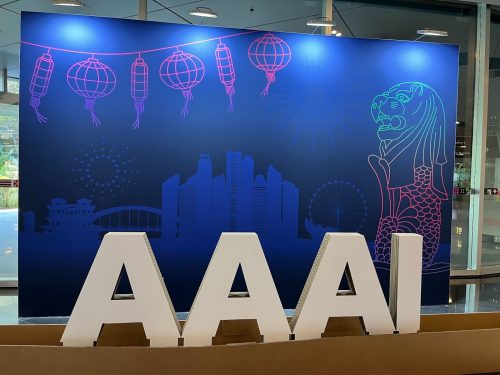
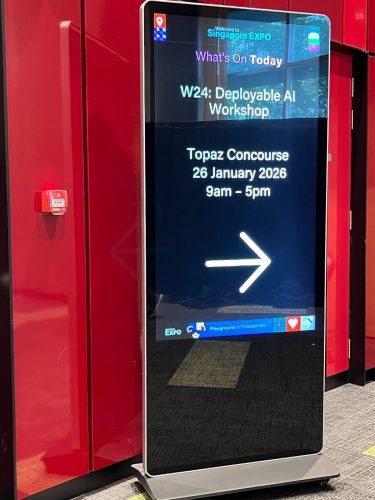
The Deployable AI workshop focuses on how to actually use and release AI models in the real world. It included keynotes from professors, oral presentations, and poster sessions. In the keynotes, the professors shared their recent work. Professor Ramayya Krishnan from Carnegie Mellon University spoke about the gap between a model’s high score on a leaderboard and the constraints of real-world deployment. He suggested treating model selection as a problem that balances user needs, costs, and rules. Professor Pradeep Varakantham from Singapore Management University gave an overview of a framework his team built to improve LLM safety, teaching models to imitate “good” behaviors and avoid “bad” ones. The presentations covered a wide range of topics, from traffic forecasting to better ways for continuous fine-tuning where historical data could not be accessed. Even though it was hard to fully understand everything in such a short time, the talks were really interesting and gave me ideas for future research.
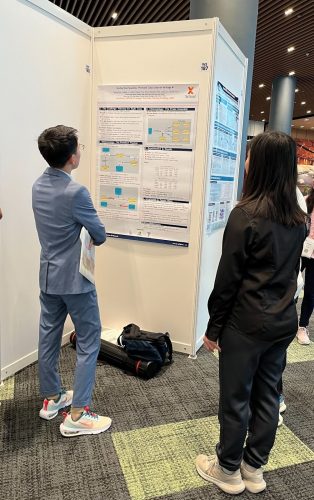
The poster sessions took place between the speeches. This was my main responsibility. I stood by our poster, greeting attendees, explaining our work, and answering their questions. I also got great suggestions for future improvements. When I had the chance, I walked around to see what others were doing. There was a lot of interesting work! For example, a high school student from Saudi Arabia used AI models to improve SQL database queries. There were also presenters from the industry showing work actually deployed in their companies, such as document filtering at ExxonMobil and fairness detection in the gaming industry. There were also several AI applications in the biology field.
Overall, my first research conference was an exciting and eye-opening experience. As a high school student, having formal research discussions with college students, researchers, and professors made me feel proud and motivated to keep working in this area. Plus, Singapore is such a beautiful and vibrant city! I really enjoyed the food and scenery, and I would highly recommend visiting.