We had the chance to sit down with the Founder & Project Director, Pages for the Future: Lilou Francy Lavenant to hear about the club focus and what they have been up to:
Bio:
Lilou Francy Lavenant is the founder of Pages for the Future, a youth-led educational initiative created to make learning more engaging and accessible for children. She leads the development of its educational resources, international projects and growing student volunteer network.
What is Pages for the Future, and what is your primary mission?
Pages for the Future is a youth-led educational initiative and school club that turns student ideas into real-world impact. Our mission is to make education more engaging and accessible by creating interactive educational resources and bringing them directly to children through book distributions, classroom activities and international projects.
How did Pages for the Future begin?
It started with a simple idea: I wanted to create a student-led project where young people could use their creativity and skills to make a real difference through education. What began as the idea for a school club gradually developed into a larger initiative.
I then built a team around the project with Niccolò Pirri, Co-Founder & Partnerships, and Valeria Soler and Carla Recio, Communications & Operations. Together, we transformed the initial idea into a real initiative: developing our educational book, building partnerships, organising its production and preparing our first international distribution in Thailand.
What was the most ambitious project you have undertaken?
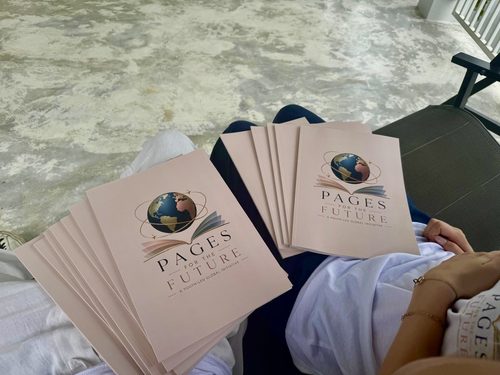
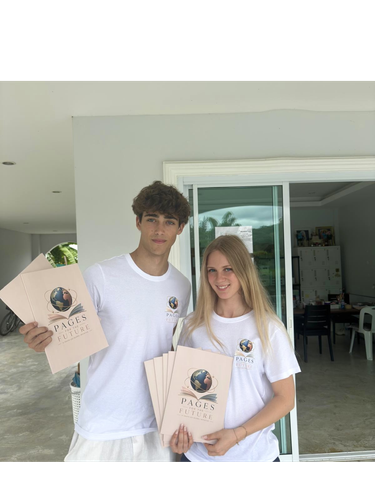
Our first international mission took place in Chiang Mai, Thailand, in August 2026. We produced more than 100 educational books, targeting +400 students and brought them to children in local schools. Rather than simply donating the books, we worked directly with the children in their classrooms, using the activities we had created to teach, play and learn together.
Seeing something that had existed on our computers for months suddenly being used by children thousands of kilometres away was an incredible moment.
What makes the Pages for the Future book different?
Pages for the Future was designed to make children active participants in their own learning. Instead of chapters and traditional exercises, the book takes children through 20 interactive missions, where they explore everything from science, history and world cultures to emotions, sustainability, money, inventions and space.
Each mission combines visual learning, storytelling, challenges, games, teamwork and real-world thinking, encouraging children to question, experiment, create and collaborate. The book also introduces them to different cultures and global perspectives, making learning feel connected to the world around them.
Most importantly, it is not a book we simply distribute and leave behind. We bring it into the classroom and teach through it, interacting directly with the children and turning each distribution into a shared educational experience. The aim is to give children more than knowledge: curiosity, creativity, confidence and the feeling that learning can open up their world.
What has been your proudest moment so far?
Definitely seeing the children in Thailand holding and using the books for the first time. We had spent months developing every part of the project, so watching the children participate, ask questions, laugh and engage with activities we had created made all of that work feel real.
It also made us realise that Thailand was not the end of the project—it was our first mission.
How can students get involved?
Pages for the Future is now growing as a school club and student volunteer network. Students can contribute in many different ways, including creating educational content, fundraising, communications, partnerships, events and preparing future distributions.
We want students to bring their own skills to the initiative. You do not have to be interested in only one subject—there is space for people interested in education, science, design, business, communication, languages or social impact.
What are your long-term goals?
Our goal is to take Pages for the Future beyond one country or one edition. We want to organise further international distributions, develop new educational resources and editions for different ages, build partnerships with schools and organisations, and create a growing network of young volunteers.
Ultimately, we want Pages for the Future to become a platform through which young people can help create educational opportunities for other children around the world.
Anything else you would like to say to Ecolyst readers?
One of the biggest things I have learned is that you do not need to wait until you are older to start something meaningful. Before Pages for the Future, I started developing LinkTeen, an educational platform designed to help young people discover opportunities and build their future. Pages for the Future then grew from another idea into something tangible that has already reached real classrooms and real children.
Both projects have taught me the same thing: an idea only becomes meaningful when you decide to act on it. If there is something you care about, start building it, find people who believe in it and don’t be afraid to think bigger. Young people are not just preparing to make an impact in the future — we can start creating it now.
Non Profit/Club: Pages for the Future (PFTF)
Website: pagesforthefuture.com
Instagram: @pages_for_the_future