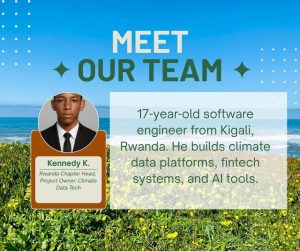
By Kennedy K. – Ecolyst.org Rwanda Chapter Head, Project Owner: Climate Data Tech, Ecolyst
I didn’t choose coding. Coding chose me – or more accurately, a national exam score did.
In 2024, I passed the Rwandan National Examinations for O’Level and placed in the top students in the country. That score didn’t just earn me a certificate. It earned me a place at Rwanda Coding Academy – one of the most competitive tech schools in the country – to study Software Programming and Embedded Systems.
Before that September, I had never written a line of code. I walked into RCA knowing nothing about programming. I walked out of my first semester knowing that this was what I wanted to do with my life.
What Rwanda Coding Academy Is Like
There are 80 students in my cohort. The quality of life is genuinely good, but the bar is high — you have to work hard to perform at a good level. The culture is built around cooperation. You don’t get far here alone. Big projects get done in teams, and that’s how the school is designed.
We have a STEM club and CyberKnights for cybersecurity enthusiasts. We attend almost every competition that happens in the country – hackathons, CTFs, tech challenges. It’s competitive but not cutthroat. People push each other up rather than tear each other down.
That environment changed everything for me. Within my first year, I was building production systems – not toy projects, not class assignments, but things that solve real problems for real people.
What I’ve Built
In two years, I’ve shipped four projects that I’m genuinely proud of:
● Community Voice EWS is a two-way disaster early-warning platform for the IGAD region. It pulls live hazard data from ICPAC’s GeoServer – flood zones, drought risk, rainfall anomalies – and combines it with crowd-sourced SMS reports. Someone in a flood-prone area sends a text describing what they’re seeing. The system receives it through Africa’s Talking, runs it through a bilingual English/Swahili NLP pipeline, classifies the hazard, and plots it on a map alongside the satellite data. The result is a two-way feedback loop between climate science and community experience. It was built for the IGAD Hackathon 2026 and is live at community-voice-ews.onrender.com.
● Hydro Orbit is a solar-powered IoT irrigation system. ESP32 sensors collect environmental data – soil moisture, temperature, humidity. A FastAPI backend processes the readings. A React dashboard visualizes them. The goal is to give smallholder farmers in East Africa access to precision agriculture without the cost of commercial systems.
● AFRPowerOS is an open intelligence platform for African energy infrastructure data. It has 11 GitHub stars and is aimed at making energy data more accessible for researchers and policymakers across the continent.
● Forest Guard Agent is an AI-driven environmental monitoring system that uses machine learning to detect changes in forest cover and environmental conditions.
I work in TypeScript/React on the frontend, Python/FastAPI on the backend, and I’ve contributed 21 merged pull requests to open-source projects across 16 repositories – including matcha (a Go email client), Render CLI, and Future AGI (a Python ML framework with 1,700+ stars). I have 91 public repositories on GitHub.
Why Climate Tech Matters in Rwanda
Rwanda is one of the most climate-vulnerable countries in Africa. The country is landlocked, heavily dependent on rain-fed agriculture, and increasingly affected by flooding, drought, and shifting rainfall patterns. Lake Kigali is rising. Nyungwe Forest is changing. The patterns that farmers have relied on for generations are becoming unreliable.
But Rwanda is also one of the most forward-looking countries on the continent. The government invests in technology. The infrastructure for digital services is strong. There’s a genuine appetite for innovation.
The gap isn’t ambition or talent, it’s tools. Climate data exists, but it doesn’t reach the people who need it. Warning systems exist, but they’re one-way and inaccessible. Technology exists, but it’s built for contexts that don’t match the realities of rural East Africa.
That’s the gap I want to fill. Not with flashy demos, but with systems that actually work — offline-first, bilingual, SMS-accessible, built for the phones people already have and the languages they already speak.
The Hard Parts
Four things hit hardest when you’re 17 and building in Kigali:
● Credibility. Age is a barrier. When I cold-email investors or apply to roles, being 17 means I have to work twice as hard to be taken seriously. The work speaks eventually, but getting the first look is the hardest part.
● Network. Finding people building what I’m building locally is hard. Most people my age are learning fundamentals. I’m trying to ship production systems. The gap between where I am and where the local ecosystem is creates isolation.
● Money. I can’t attend conferences, workshops, or paid programs. Most of the high-signal opportunities in the African tech ecosystem happen in Lagos, Nairobi, or Cape Town. Getting there costs money I don’t have.
● Time. School takes most of my day. RCA is rigorous. Building what I’m building requires deep focus blocks that are hard to find between lectures, labs, and assignments.
What Drives Me
I’ve had multiple mentors, but they’re mostly other young people who have already walked the path I’m walking and succeeded. I learn from them and they mentor me. They’re not famous names, they’re people who were in my position a few years ago, figured it out, and now help me avoid the same mistakes. That’s the kind of mentorship that actually moves the needle.
My family is supportive. They support me in every way they can within their means. They may not fully understand the technical details of what I’m building, but they understand that I’m serious about it and they back me. That support — even if it’s just belief and encouragement — matters more than people realize when you’re building something from scratch at 17.
Where I’m Going
In five years, I want to build a global reputation in technology. Not just be known locally, be recognized in the global tech scene as someone who builds impactful stuff. I want to go global. That means building things that matter, earning credibility through work, and becoming a figure that other young builders in Africa can look at and say “that path exists.”
Whether that’s through climate tech, fintech, AI, or something I haven’t started yet, the goal is impact and recognition on a global scale.
I’m 17. I’m in Kigali. I’m building. And I’m just getting started.
Kennedy K. is a 17-year-old software engineer from Kigali, Rwanda, studying at Rwanda Coding Academy (class of 2027). He is the Rwanda Chapter Head and Project Owner of Climate Data Tech at Ecolyst. He builds climate data platforms, fintech systems, and AI tools.