by the Ecolyst Spotlight Project Team (edited on top of Gemini notes)
Bingqing is not your typical leader. A biochemist with a gene patent and a Master’s in food nutrition, she is also a celebrated author and the Executive Vice President of Silicon Valley Women Alliance (one of leadership positions she holds). But perhaps her most defining role is that of a “bridge”- between complex science and daily life, and between Silicon Valley and rural education.
We sat down with her to discuss her 20-year journey of science, strategy, and service.
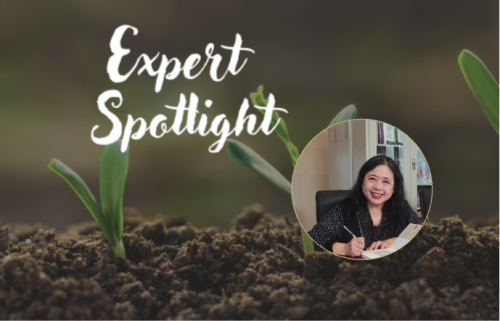
Q: Can you share your personal journey into green tech? What opportunities did you encounter?
Bingqing: While my background is in food science, my heart has always been in the field, looking for ways to solve the most fundamental human puzzle: how do we feed a growing world without breaking the planet?
I’ve found that the greatest opportunity lies in the fact that science is the universal language. It doesn’t matter if I’m presenting in a Silicon Valley conference or sitting on the floor with students at my old high school or college; the data speaks a truth that everyone understands.
I realized early on that my unique path was actually my greatest strength. I was there to be a translator. My mission is to take high-tech, ‘big-picture’ innovation and translate it into something that meets real-world human needs—whether that’s a more resilient grain of rice or “a spark of curiosity in a student’s eyes.”
Q: You’ve been working with rural schools for over 20 years. How does this link to women being changemakers in this field?
Bingqing: This is very personal for me. In the early 2000s, we raised funds to build a school in a rural area. Since then, we’ve organized yearly trips where students from the U.S. bring supplies and teach classes. Most recently, through the collaboration with IEEE Smart Village initiative, we just completed our 5th consecutive year of the “High-Quality Classrooms” project and are now planning for 2026. We use internet and cloud technology to bridge the gap, bringing “Smart Village” concepts—Energy, Education, and Entrepreneurship—directly to remote schools.
Just this past June, we provided classes to schools like TY Primary and the SVWA Xinxin Primary. We aren’t just teaching basics; we are teaching:
- “Energy Superheroes”: Helping kids understand energy storage and magnetism.
- Drone Technology: Showing them how drones can be used for modern agriculture and disaster relief.
- Renewable Energy: Planting the seeds for a green-energy future.
This work taught me that women are the natural stewards of sustainability. In almost every culture, women manage the “household ecology”—the food, the health, and the education. Women should continue:
- Lead with Empathy: Don’t just look at a gene sequence; look at the child who will eat the crop. My work in rural education reminds me that science is for people.
- Build Global Networks: we create a community where women don’t have to choose between being a high-level executive and a humanitarian.
- Be the Bridge: I tell the girls I mentor: “Your unique life story isn’t a barrier—it’s your superpower.”
Q: What are the biggest hurdles to scaling green technologies, especially in agriculture?
Bingqing: In my book, Great Power Grain, we look at food as a “Global Chessboard.” The hurdles aren’t just technical; they are strategic and economic.ge the gap between science and finance. we show that sustainability is actually the best long-term financial investment a country can make.
The “Rice Bowl” Paradox: Nations are hesitant to adopt new, unproven green tech if it risks their immediate food security. As we say in the book, “holding the rice bowl firmly in one’s own hands” is a matter of national security. We need “Frugal Innovation.” In the book, we explore how food isn’t just about calories—it’s about civilization. We look at:
- The Global Landscape: How crops shaped history and how major powers manage their food today.
- The Path of Production: The science behind how we grow food now and the critical technologies of the future.
- The Strategy of Security: Explaining China’s food security principles and analyzing “food wars” from ancient times to the modern day.
In an era of global pandemics, financial instability, the war, and accelerating climate change, the security of a nation’s grain supply becomes the ultimate foundation. If you care about the state of the world, you have to care about the state of the soil.
Closing Thoughts: A Message to the Future
Bingqing: “If I could leave you with one thought, it’s this: Don’t wait for ‘perfect’ conditions to make a difference. When we started fundraising for rural schools in the early 2000s, we didn’t have a global platform or a best-selling book; we just had a map and a desire to help. Today, as we enter the 6th year of our ‘High-Quality Classrooms’ project in the mountains, the technology has changed—we use drones and virtual meetings now—but the mission is the same.
To the students in science: your education is a tool, but your empathy is the engine. Don’t just study for the grade; study so you can be the person who brings ‘Smart Village’ technology to a community that’s been waiting for it.
And to my fellow women in tech: stay bold. Whether you are navigating a boardroom in Silicon Valley or a mountain path in Sichuan, remember that you are the bridge. Our mission is to show that the “Great Power” isn’t just about grain or money—it’s about the power to empower others.