By Tiffany W. (11th Grade)
Abstract
The purpose of this experiment was to determine the speed of sound in air using resonance in a
tube closed at one end and open at the other. Different tuning fork frequencies were used to
produce standing waves within a PVC pipe partially submerged in water. The resonant lengths of
the air column were measured and used to calculate the wavelength and speed of sound. The
average experimental speed of sound was found to be approximately 329.7 m/s, which differs
from the accepted value of 343 m/s by about 3.88%.
Purpose
To measure the speed of sound in air by listening for resonating standing waves in a tube closed at one
end and open at the other.
Materials
● Bucket filled with water
● 0.5-inch diameter PVC pipe
● Tuning forks (250 Hz, 500 Hz, and 1000 Hz)
● Paper towels
● Ruler or meter stick
● Calculator
● Pencil and paper
Background Information
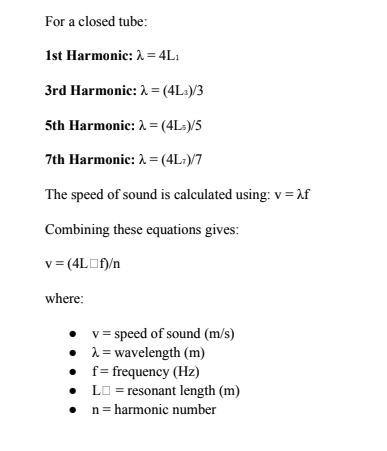
When a tube is closed at one end and open at the other, standing waves form only at odd harmonics. The
resonant lengths of the air column can be used to determine the wavelength of the sound wave.
Procedure
- Fill a bucket approximately three-quarters full with water.
- Insert the PVC pipe vertically into the water.
- Strike a tuning fork and hold it approximately one inch above the pipe opening.
- Slowly raise the pipe from the water while holding the tuning fork above it.
- Listen for a loud resonant sound indicating a standing wave has formed.
- Measure the length of the air column from the water level to the top of the pipe.
- Record the tuning fork frequency, harmonic number, and resonant length.
- Repeat the process for as many harmonics as possible.
- Repeat the experiment using different tuning fork frequencies.
Data Analysis
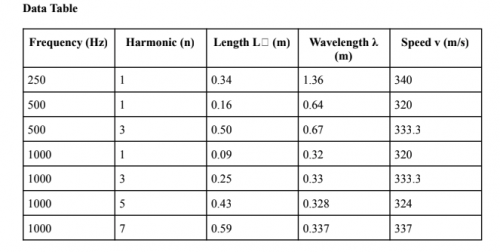
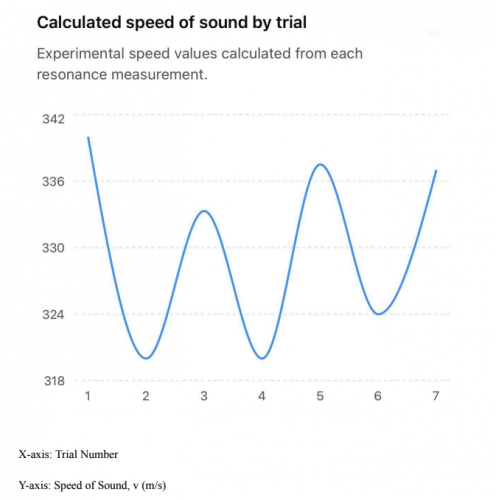
The calculated speeds of sound ranged from 320 m/s to 340 m/s. Most values were within
approximately 7% of the accepted value of 343 m/s, indicating reasonable agreement between
theory and experiment.
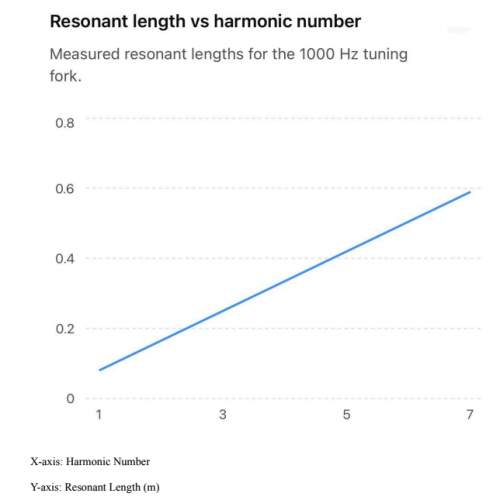
For the 1000 Hz tuning fork, the calculated speed generally increased as higher harmonics were
measured. The first harmonic produced a value of 320 m/s, while the seventh harmonic produced
a value of 337 m/s. This trend suggests that measurements became more accurate at longer
resonant lengths because the relative effect of measurement uncertainty decreased.
The average experimental speed of sound was calculated to be 329.7 m/s. Compared to the
accepted value of 343 m/s, this corresponds to a percent error of approximately 3.88%. The
relatively small error indicates that the resonance method provides a reliable way to determine
the speed of sound in air.
The relationship between harmonic number and resonant length was consistent with the
theoretical model for standing waves in a tube closed at one end and open at the other. As the
harmonic number increased, the resonant length also increased, supporting the equation:
L= nλ/4
This agreement between experimental observations and theory demonstrates the predictable
behavior of standing waves in air columns.
Results
The measured speeds of sound were:
340 m/s, 320 m/s, 333.3 m/s, 320 m/s, 333.3 m/s, 324 m/s, and 337 m/s.
Average Speed:
Average = (340 + 320 + 333.3 + 320 + 333.3 + 324 + 337) ÷ 7
Average = 329.7 m/s
Error Analysis
The accepted speed of sound in air at room temperature is approximately 343 m/s.
Percent Error:
Percent Error = |343 − 329.7| ÷ 343 × 100
Percent Error = 3.88%
Possible sources of error include:
● Difficulty determining the exact point of maximum resonance by listening.
● Movement of the water level during measurements.
● Inaccurate measurement of the air-column length.
● Background noise interfering with resonance detection.
● Variations in room temperature affecting the speed of sound.
One source of systematic error is the end correction associated with the open end of the PVC tube. In
reality, the displacement antinode forms slightly outside the tube opening, causing the effective resonant
length to be greater than the measured length. Because this effect was not included in the calculations, the
measured wavelengths and corresponding speeds of sound may have been slightly underestimated.
Accounting for end correction would likely reduce the percent error and improve agreement with the
accepted value.
Conclusion
The results demonstrate that resonance can be used as an effective method for determining the speed of
sound in air. Despite small measurement uncertainties, the experimental value was within approximately
3.88% of the accepted value, providing strong support for the theory of standing waves in closed air
columns. This investigation illustrates how wave behavior can be analyzed through measurable physical
quantities such as frequency, wavelength, and resonant length.